

How AI Detection Actually Works on Security Cameras
According to the Australian Bureau of Statistics, the share of households broken into rose from 1.8% to 2.1% between 2022-23 and 2023-24, an extra 32,000 homes across the country (ABS, Property crime rises). That is the backdrop most people are thinking about when they start looking at an AI security camera instead of a basic motion-sensor model.
The word “AI” gets used loosely in camera marketing, so it is worth being precise. An AI security camera does not just notice that something moved. It works out what moved, and that single difference changes almost everything about how useful the camera is day to day.
This guide breaks down how AI detection actually works, what it can and cannot tell apart, where the processing happens, and what Australian law says about using one at home. We will also look at smart detection security camera features more broadly, since AI detection rarely works alone.
Key Highlights:
- An AI security camera classifies what caused motion (person, vehicle, animal) instead of just flagging that something moved.
- Traditional motion detection reacts to pixel changes, which is why it is triggered by rain, shadows, and moving trees.
- Most consumer AI cameras, including NV NightVision models, process detection on the device itself rather than sending raw footage to the cloud first.
- AI human detection cuts false alerts significantly, but poor lighting, unusual angles, and partial obstruction can still cause it to miss things.
- Using a camera with AI detection at home is legal in Australia, provided you follow state surveillance rules around neighbouring properties and audio recording.
What “AI Detection” Actually Means on a Camera
Every AI security camera runs a small piece of trained software, usually a neural network, that has learned what a human being looks like from thousands of reference images. When motion is picked up, that software analyses the shape before deciding whether to send an alert.
This is object classification, and it is the core of what separates an AI camera from an older motion-only model. The camera is not asking “did something move,” it is asking “what moved, and is that worth telling someone about.”
Most AI security cameras extend this into a few categories: person, vehicle, and animal, with some models adding parcel or face recognition on top. NV NightVision cameras focus on reliable human detection as the primary trigger, since that is what actually matters for a break-in alert.
AI Detection vs Traditional Motion Detection
Traditional motion detection compares pixels between video frames. If enough pixels change between one frame and the next, the camera assumes something moved and sends an alert, regardless of what actually caused the change.
That is why an older camera will happily notify you about a possum crossing the fence, a shadow shifting as clouds pass, or a gum tree swaying in the wind. None of that is useful, and after a week of it most people stop checking their notifications entirely.
An AI camera keeps the same motion sensor as a starting point but adds a classification step before the alert goes out. Distinguishing a person from a swaying branch is what actually stops a camera app becoming background noise you tune out.
What an AI Security Camera Can Tell Apart
Object classification on a consumer AI camera generally sorts movement into three broad groups: human, vehicle, and animal. The system is trained to recognise the general shape, proportions, and movement pattern typical of each.
A person walking upright and an animal moving low to the ground produce very different silhouettes, and that is largely how the software tells them apart. It is pattern recognition rather than anything resembling actual understanding.
This is where smart detection security camera features become genuinely practical. Instead of a blanket “motion detected” push notification, you get “person detected at the front gate,” which is the difference between an alert you act on and one you swipe away.
NV NightVision’sactive deterrence approach builds directly on this. Once a camera classifies a detection as a person, it can trigger a built-in siren or two-way audio warning automatically, rather than waiting for you to review footage after the fact.
Where the AI Processing Actually Happens
There are two ways an AI camera can run its detection software: on the device itself, or by sending footage to a cloud server for analysis first. Both approaches are used across the market, and the difference matters more than most buyers realise.
On-device processing means the camera’s own chip runs the detection model locally, without needing to upload raw video anywhere before deciding whether an event matters. This tends to mean faster alerts and less dependence on a fast, always-on internet connection.
Cloud-based processing can offer more advanced classification since it is not limited by the camera’s onboard hardware. The trade-off is a small delay while footage uploads, plus a reliance on the service staying online and the connection holding up.
NV NightVision cameras run AI human detection on the device, which keeps alerts fast and functional even during a patchy home internet connection, a genuinely common issue in regional Australia.
Why Fewer False Alerts Actually Matters
Alert fatigue is a real, well-documented problem. When a camera sends dozens of irrelevant notifications a week, most people either mute the app or stop checking it, which defeats the entire purpose of having a camera.
AI detection is the fix for that specific problem. By filtering out cars, trees, weather, and pets before a notification ever reaches your phone, the alerts you do get are far more likely to represent something worth your attention.
This is also what makes acamera with a built-in siren genuinely useful rather than a gimmick. A siren that only fires on confirmed human detection, not on every passing cat, is one people actually leave switched on.
What AI Detection Still Gets Wrong
AI detection is not flawless, and any brand that claims otherwise is overselling it. Poor lighting, an awkward camera angle, or a person partially hidden behind a car can all cause a missed detection or an incorrect one.
Fast movement close to the lens can also confuse classification, since the software has less time and less clean image data to work with. This is one reason camera placement still matters as much as the detection technology itself.
Good night vision range helps here more than people expect, because the AI model needs a reasonably clear image to classify accurately. A camera with strong low-light performance gives its own AI detection a genuinely better chance of getting it right.
AI Detection and Your Privacy Rights in Australia
Running an AI security camera at home is legal across Australia, but the footage it captures is still covered by ordinary privacy expectations. According to theOffice of the Australian Information Commissioner, footage that identifies a person is treated as personal information once an organisation covered by the Privacy Act 1988 is involved.
For a private household, the bigger day-to-day issue is state-based surveillance law rather than the federal Privacy Act. Camera placement and audio recording are the two areas where homeowners most often get caught out, and the rules differ by state, so it pays to check thesecurity camera laws that apply where you live.
Renters face an extra layer of consideration on top of this, since installation itself can be restricted by a lease. If that applies to you, our guide tosecurity cameras for renters covers no-drill options that still support full AI human detection.
AI Detection Built for Australian Conditions
AI detection is only as good as the camera running it, and Australian conditions are genuinely demanding on outdoor electronics. Harsh UV exposure, coastal salt air, and summer heat all put real stress on a camera’s housing and internals over time.
NV NightVision’s outdoor range is rated from -20°C to 50°C with up to 95% humidity tolerance, which covers everything from a Tasmanian winter to a tropical North Queensland wet season without the camera needing to be brought indoors.
That weatherproofing matters directly for AI accuracy too. A camera lens fogged with condensation or glaring from direct sun gives the detection software a worse image to classify, so reliable weatherproofing is part of what makes AI detection work consistently, not a separate spec sheet item.
Smart Features That Work Alongside AI Detection
AI detection rarely operates in isolation. It usually sits inside a broader smart camera system that includes app alerts, voice assistant integration, and two-way audio, all working from the same human detection trigger.
NV NightVision cameras supportGoogle Home and Alexa compatible setups, so a confirmed person detection can announce on a smart speaker as well as push a phone alert, which matters if you are in another room without your phone nearby.
NV NightVision’s Pick for AI Detection: The G11
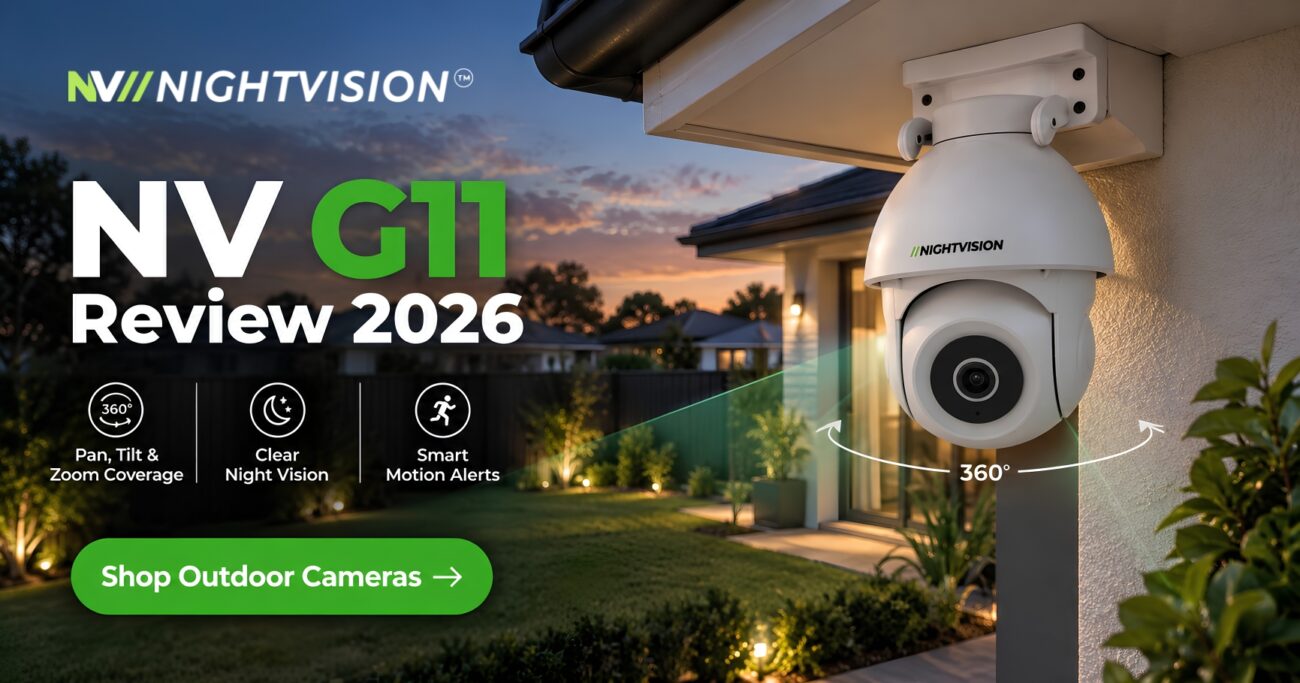
If AI detection accuracy is the priority, the NV Ratri G11 is the strongest option in the NV NightVision range. It is a pan-tilt-zoom camera with 355-degree coverage, AI auto-tracking, and 4MP resolution, and you can see the full model alongside NV NightVision’s otheroutdoor security cameras to compare specs side by side.
Because the G11 physically follows a confirmed human detection with its pan-tilt motor, it keeps a moving person in frame rather than losing them at the edge of a fixed lens. That is a meaningfully different result to a static camera relying on AI classification alone.
Designed in Australia, the G11 pairs its AI detection with a built-in siren, two-way audio, and H.265 compression to keep storage efficient. Current pricing is not confirmed here, so check the product page directly rather than relying on a figure that may be out of date.
Every NV NightVision camera, including the G11, is backed by a 1-year warranty, and that sits on top of the automatic consumer guarantees every product sold in Australia carries under the Australian Consumer Law regardless of what any individual manufacturer warranty states (ACCC, Warranties).
For a broader comparison across the whole range, ourfull comparison of the best security cameras in Australia is worth reading before you decide which model fits your property.
Picking a Camera Whose AI Detection You Can Actually Trust
The honest takeaway is that AI detection is genuinely useful, but it is not magic. It works by classifying motion rather than understanding a scene, and its accuracy still depends heavily on lighting, placement, and camera build quality.
Before buying, check whether detection runs on-device or in the cloud, what the camera’s weatherproofing rating actually is, and whether false-alert filtering is backed by real specs rather than a marketing claim.
If you are ready to compare specific models,browse the full NV NightVision range and check current specs and pricing directly on each product page.
Common Questions About AI Security Cameras in Australia
What does AI detection mean on a security camera?
AI detection means the camera analyses motion to work out what caused it, typically sorting movement into human, vehicle, or animal categories. Instead of alerting on every pixel change, it only notifies you once it classifies the movement as something worth flagging, usually a person.
How is AI detection different from regular motion detection?
Regular motion detection reacts to any pixel change between frames, including rain, shadows, and moving trees. AI detection adds a classification step on top of that same trigger, filtering out irrelevant movement so alerts represent an actual person, vehicle, or animal rather than background noise.
Can AI cameras tell the difference between a person and an animal?
Yes, that is the core function of AI human detection. The software is trained on the general shape, height, and movement pattern typical of a person versus an animal, which is usually accurate in good lighting but can occasionally misclassify in poor conditions.
Does AI detection process footage on the camera or in the cloud?
It depends on the model. NV NightVision cameras run detection on-device, which keeps alerts fast without depending on uploading raw footage first. Other brands process detection in the cloud, which can offer more advanced classification at the cost of a small delay.
Will an AI security camera actually reduce false alerts?
Significantly, yes. By filtering out weather, pets, and passing traffic before sending a notification, AI detection cuts the volume of irrelevant alerts compared to a plain motion-sensor camera, which is the main reason most buyers upgrade to one.
What can cause an AI camera to miss a real event?
Poor lighting, an obstructed view, an unusual camera angle, or very fast movement close to the lens can all reduce classification accuracy. Good night vision range and sensible camera placement both help the AI model work with a clearer image.
Is it legal to use AI detection cameras at home in Australia?
Yes, home security cameras with AI detection are legal across Australia. State-based surveillance rules still apply around not filming private areas of a neighbouring property and around recording audio without consent, so it is worth checking your state’s specific rules.
Do AI security cameras record audio as well as video?
Most models with two-way audio can record sound, though audio recording without consent of everyone involved can breach state surveillance laws in Australia. Check your camera’s audio settings and your state’s rules before relying on audio capture.
Does AI detection still work at night or in bad weather?
It can, but accuracy depends on image quality. Strong night vision range and weatherproofing that keeps the lens clear of fog or glare both give the AI model a better image to classify, which is why those specs matter as much as the AI software itself.
Which NV NightVision camera has the strongest AI detection?
The NV Ratri G11 pairs AI human detection with a pan-tilt motor that physically tracks a confirmed person across its 355-degree range, which keeps moving subjects in frame in a way a fixed-lens camera cannot match.


Pingback: NV S8 Review Australia 2026: Budget Indoor Camera Tested