
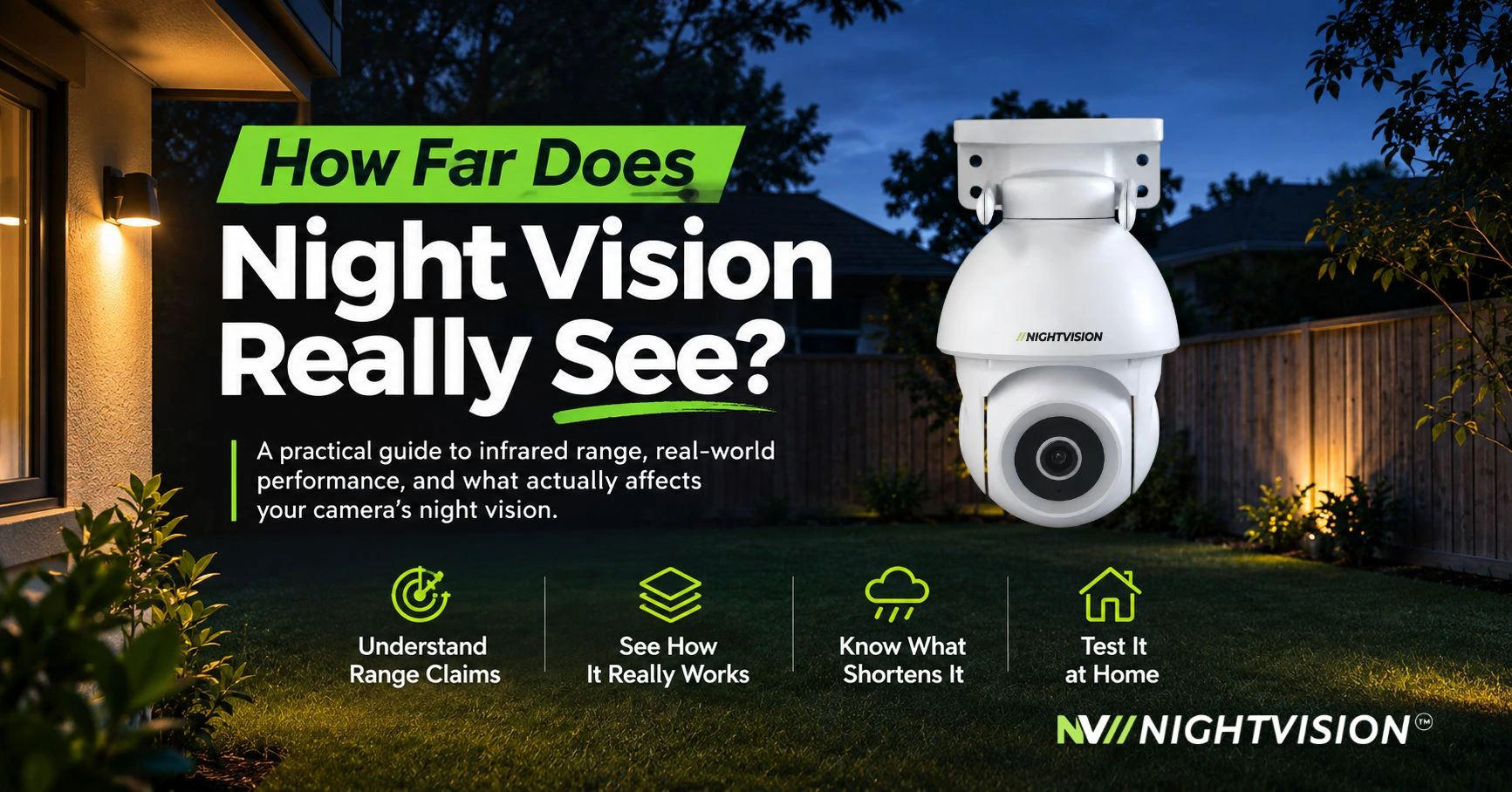
Security Camera Range: How Far Can Night Vision Actually See
Walk outside after dark and look at the back fence. Now ask how much of it your camera would really pick up. The gap between the number on the box and the footage on your phone is where most night vision disappointment starts.
This guide explains night vision camera range Australia buyers can count on, and what happens once you leave the lab figures behind. You’ll see what an IR range security camera number means and what shortens it.
You’ll also learn how to check an infrared range camera at your own front door. NV NightVision cameras appear near the end, matched to the jobs they suit.
Key Highlights:
|
A Night Vision Camera Range Australia Shoppers See on a Listing Is a Best Case
A listing will usually quote a distance in metres for infrared. That figure comes from the maker, and it describes how far the infrared light reaches under good conditions.
Treat it as a ceiling. A night vision camera range Australia retailers quote is a statement about the light, and not about the picture you’ll get.
Your yard has dust, a white garage door, a neighbour’s fence and a few spider webs, and none of them appear on the spec sheet.
Real use asks more of a camera than the figure suggests. People type “how far can a security camera see at night” into Google, and the honest answer is that it depends on what you want to see.
Detecting Movement Is Easier Than Recognising a Face
Installers talk about four levels of seeing: detect, observe, recognise and identify. Each level needs more picture detail than the one before, so each one works over a shorter distance.
The international standard for CCTV planning, IEC 62676-4 application guidelines,covers selecting, planning, installing and testing video surveillance systems . It’s a handy reminder that range is a design choice made for a purpose and not one number.
Decide which level you need at each spot. A porch camera should identify a visitor. A back fence camera may only need to detect that someone is there.
Take a driveway as an example. Spotting a car at the far end is easy. Reading a plate or describing the driver from that distance is a much bigger ask, and an IR range security camera figure rarely promises it.
Infrared Range Camera Basics Explain Why the Picture Turns Black and White
Once you know how the picture is made in the dark, the range figures make more sense. Two methods do most of the work in home cameras.
Infrared LEDs Light the Scene and the Lens Collects the Reflection
Most outdoor cameras have small LEDs around the lens that give off infrared light. According to NASA, infrared sits in the part of the spectrum just beyond red, andNASA’s page on infrared waves explains that the human eye can’t see it.
The camera’s sensor can see it, so the scene looks lit to the camera while it looks dark to you. Pale, shiny surfaces reflect infrared well and look bright. Dark, rough surfaces soak it up.
When infrared mode switches on, the picture turns black and white. That’s normal, and it’s how a typical infrared range camera works.
Colour Night Vision Needs Some Ambient Light
Colour night vision works another way. A wide aperture and a sensitive sensor gather faint light from a porch lamp or a streetlight, and the camera keeps colour in the picture.
With no light at all, a colour model falls back to infrared. The NV V6Z listing, for example, gives a stated infrared range of about 8 to 10 metres, using 8 infrared LEDs and 12 additional LEDs.
Colour pays off when you need to describe what you saw. A red jacket or a blue ute is far easier to report than a grey shape.
Five Everyday Factors Decide How Far a Camera Sees After Dark
A camera rated for a long reach can still disappoint on a bad night. The question “how far can security camera see at night” has five everyday answers, and most cost nothing to fix once you know about them.
Resolution and Lens Decide How Much Detail Survives Distance
Infrared light can travel a long way and still give you a useless picture. If too few pixels land on a distant face, extra light won’t repair that.
A 4MP camera suits a front door or a driveway well. Our4MP vs 4K comparison explains what extra pixels buy and what they cost.
Lens choice matters as well. A wide lens shows more of the yard but makes everything smaller, while a narrower view gives more detail on a smaller patch.
Glare From Walls and Fences Can Wash Out the Frame
Infrared bounces off pale surfaces. A white garage door or a light fence close to the camera can reflect enough light to dim everything beyond it.
The same thing happens when the lens sits right against an eave or a wall. The infrared light reflects straight back into the lens and the picture goes white in the middle.
The fix is placement. Mount the camera so it looks past nearby surfaces and not along them, then check the angle after dark.
Dust, Smoke, Rain and Fog Cut the Usable Distance
Particles in the air scatter infrared light. Rain and fog do it, and so does dust, which makes the picture hazy and shortens the distance you can read.
Australian conditions throw plenty of this at a camera. Dust on a rural road and smoke in a bad fire season both cut visibility.
Salt spray near the coast leaves a film on the lens that scatters infrared light as well, so a quick wipe often restores more distance than you’d expect.
Don’t treat a hazy clip as a faulty camera. Wipe the lens, wait for a clear night and check again.
Insects and Spider Webs Cause Flares and False Alerts
Lit cameras attract bugs. Scitech’s Particle magazine explains thatmoths and other insects are drawn to artificial light, although nobody fully knows why.
A moth fluttering across the lens at night looks enormous in infrared footage. A web near the lens can glow as it bounces the light back, and it can trigger endless motion alerts.
Brush webs off the housing every few weeks. AI human detection helps here because it can ignore a moth, and ourAI detection explainer shows how it filters alerts.
Mounting Height and Angle Change What You Can Recognise
A camera mounted high and tilted steeply sees the tops of heads and loses faces. A camera at head height or slightly above gives better faces, but it’s easier to reach.
Mount it out of easy reach under an eave, with the lens angled down only a little. Keep the lens clear of the eave edge so infrared light doesn’t flare back.
Simple Fixes Stretch the Night Range You Already Have
You don’t always need a new camera. A few cheap changes often add more usable distance than a higher spec would.
- Wipe the lens and housing every few weeks, because dust and salt scatter infrared light.
- Add a sensor light near the subject so the camera has more than infrared to work with.
- Move the camera a little so it looks past nearby walls and eaves that bounce light back.
- Trim the detection zone to skip the footpath, which cuts alerts from passing cars.
- Check Wi-Fi at the mounting spot, because a weak signal makes the live night view stutter.
Change one thing at a time and test again after dark. That way you know which fix worked.
Match the Night Vision Camera Range Australia Homes Need to the Spot You Are Watching
Work out the distance first and choose the camera second. Pace it out or use a tape measure, then write the number down.
The Front Door and Porch Need Faces More Than Distance
A front door usually sits only a few paces from the camera. Here the aim is to identify a visitor, so detail matters more than reach.
A fixed camera aimed slightly down at the doorstep does this well. Add a porch light and a colour-capable camera has even more to work with.
An infrared range camera aimed at a close doorway also risks glare from the wall behind it, so check the frame at night before you settle.
Driveways and Side Gates Need a Balance of Reach and Detail
A driveway runs further, and cars move faster than people. Ourdriveway and gate camera guide covers where to aim so you catch both a plate and a face.
At night, a light near the entry makes a big difference to recognition. Place it so it lights the subject without shining into the lens.
Sheds and Rural Gates Need Light as Well as Infrared
The further a target sits from the camera, the more you’ll rely on extra lighting. According to Victoria Police, you shouldinstall sensor lights around all buildings and sheds and place cameras to cover entry and exit points.
That advice suits a rural gate or a back shed as well as a suburban garage. A sensor light wakes up a colour-capable camera and also tells anyone nearby that they’ve been seen.
Where a shed sits far from a power point, oursolar camera guide covers the options.
Test the Night Range Before You Mount Anything
A short test after dark tells you more than any listing. Follow these steps in order, because each one builds on the last, and the result is the night vision camera range Australia conditions give your own yard.
- Pace out the distance from the planned mount to the spot you want to watch, and note it.
- Wait for full dark, then have a helper stand at that spot in dark clothing.
- Record a short clip and watch it full screen on your phone. Check that you can say who it is.
- Repeat with the helper at half the distance, and again with the outdoor lights on.
- Try it on a hazy night too, and clean the lens before you decide.
If the footage fails at the distance you need, move the camera closer, add a sensor light or choose a different model before you drill. Run the camera for a week before you settle on the final spot.
Keep the lens on your own property and away from neighbours’ windows. State surveillance laws differ, and oursecurity camera laws guide covers the basics.
Australian Consumer Law Backs You When a Listing Promises Too Much
A camera has to match how it’s described, and that includes its night range. The ACCC explains thatconsumer guarantees under Australian Consumer Law cover goods that must correspond with their description and suit any purpose the seller says they’re good for.
So if a listing promises a night range and the camera plainly can’t deliver it, you may be entitled to a remedy. Keep your receipt and take dated clips of the problem.
Contact the seller first and describe the fault clearly. A good seller would rather fix it than argue.
NV NightVision Cameras Matched to Night Range Jobs
NV NightVision cameras are Designed in Australia, and theNV NightVision outdoor cameras range covers the main outdoor jobs in this guide. Here’s how three models fit the night vision camera range Australia homes ask about.
NV T5P (SKU NV-T5P). The T5P-Ratri Bullet Outdoor Wi-Fi CCTV Camera is a fixed-angle 4MP outdoor camera with AI human detection, a built-in siren, two-way audio and H.265 compression. It suits a front door or driveway where one steady view matters.
NV G11 (SKU NV-G11). The Ratri G11 is an outdoor pan-tilt-zoom camera with 355 degree pan, 75 degree tilt and AI auto-tracking. It follows a person across a wide yard, which helps when a fixed view can’t cover the distance. OurG11 vs T5P comparison shows how to choose between them.
NV V6Z (SKU NV-V6Z). The V6Z keeps colour footage after dark when some ambient light is present, with an infrared fallback of about 8 to 10 metres in full darkness. It’s a good match for a lit porch or driveway.
Infrared range differs by model, so check each product page for the listed figure and the current price. Every NV NightVision camera carries a 1-year warranty, and Australian Consumer Law guarantees apply separately and automatically.
Your Next Step Is a Night Test at the Real Distance
Before you buy, write down the distance to each spot and the level of detail you need there. Then choose the camera and the lighting to match.
If you’re still comparing camera types, ourbest CCTV camera guide puts them side by side.
When you’re ready, thefull NV NightVision range lists every current model with its specifications. The night vision camera range Australia households need is the one that fits their own yard.
A camera that shows a clear face at your real distance beats one with a bigger number on the box. Test first, and trust the footage over the listing.
Common Questions About Night Vision Camera Range in Australia
How far can a security camera see at night?
It depends on the camera, the light and the weather. A listed infrared range is a best case in clear air. The distance at which you can recognise a person is usually shorter, so test the camera after dark at the distance you actually need.
What does infrared range mean on a security camera?
It’s the distance the camera’s infrared LEDs can light a scene well enough to record a usable picture. The IR range security camera makers list is usually measured in good conditions. Treat it as a maximum for seeing a shape, not a guarantee of clear faces.
Is the night vision range on the box accurate?
It’s accurate for the conditions the maker tested, which are usually clear and ideal. Your yard has dust, walls, insects and weather that change the result. Check the footage yourself after dark at your real mounting distance before you trust the number.
Why does my night vision footage look washed out or hazy?
Glare is the usual cause. Infrared light bounces off a nearby wall or fence and floods the lens. A dirty lens or a web near the housing can also cause it. Wipe the lens, adjust the angle slightly and check the footage again after dark.
Does colour night vision work in complete darkness?
No. Colour night vision needs some ambient light, such as a porch lamp or streetlight. In full darkness a colour camera switches to infrared and records in black and white. A sensor light gives an infrared range camera of this type more to work with.
Do rain and fog reduce night vision range?
Yes. Water droplets and dust scatter infrared light, which makes footage hazy and shortens how far you can read detail. The camera isn’t faulty on those nights. Wipe the lens, then recheck on a clear night so you can compare the two results.
Do insects and spider webs affect night vision?
Yes. Insects are drawn to light and can flutter across the lens, while webs can glow and trigger alerts. Brush them off every few weeks. AI human detection helps by ignoring most bugs, so alerts usually mean a person is in frame.
How do I test night vision range before mounting a camera?
Hold the camera at the planned spot after dark and have a helper stand at the distance you need to cover. Record a clip and watch it full screen on your phone. If you can’t say who it is, move closer or add light.
What warranty do NV NightVision cameras have?
NV NightVision cameras carry a 1-year warranty. Australian Consumer Law guarantees apply separately and automatically. If a camera has a major fault, you may be entitled to a repair , replacement or refund, whichever the law allows for your particular situation.



Add a review
Your email address will not be published. Required fields are marked *